





Ask this question in any accordion forum and you will get forty answers, most of them passionate and about half of them contradicting each other. The reason is that “piano or button” is the wrong first question.
The real first question is whether you want an instrument that plays the same note whichever way the bellows are moving. That single decision splits the accordion world in two, and it matters far more than the shape of the thing under your right hand.
The split that actually matters
Accordions come in two mechanical types.
Unisonoric instruments give you the same note on the push and on the pull. Piano accordions are unisonoric. So are chromatic button accordions. Press a button or key, move the bellows either direction, same pitch.
Bisonoric instruments give you a different note depending on bellows direction, the way a harmonica gives you different notes blowing and drawing. Diatonic button accordions work this way, which is why the older term for them is single-action. One button, two notes.
That difference drives everything else. On a unisonoric instrument the bellows are about dynamics and phrasing. On a bisonoric one the bellows are part of the note selection, so the direction you are travelling in is already decided for you by the melody. Players of each kind often describe the other as backwards, and both are right from where they sit.
The three instruments you are actually choosing between
The piano accordion
Right hand is a keyboard laid vertically down the side of the instrument, pointing in toward the bellows. The keys are rounded, smaller and lighter to the touch than piano keys, and they are reachable with one hand only.
A standard full size instrument is described as 120 bass and 41 keys. Its written right hand range is three octaves plus a major third, and the registers let you sound that an octave above or below. Smaller instruments run down through 96, 72, 48 and 12 bass, with fewer keys to match.
If you already read music or play keyboard, this is the shortest path to playing something recognisable. The note layout is one you already know.
The chromatic button accordion
Unisonoric like the piano accordion, but the right hand is three to five rows of buttons laid out chromatically. Two main layouts exist, called the B system and the C system. On five row instruments the fourth and fifth rows duplicate the first two, which gives you alternative fingerings for the same passage.
The range is the headline advantage. A chromatic button accordion reaches five octaves plus a minor third in the right hand, against the piano accordion’s three octaves plus a major third. Buttons are smaller than keys, so far more notes fit in the same physical space.
The second advantage is that a fingering pattern moves. Because the buttons are arranged chromatically, a shape you learn in one key transfers to another key unchanged. On a piano keyboard the same melody in a different key means a different pattern of black and white notes.
The cost is that some fingering positions ask you to twist the wrist, and that switching between alternative patterns can get in the way when you are sight reading something difficult.
The diatonic button accordion
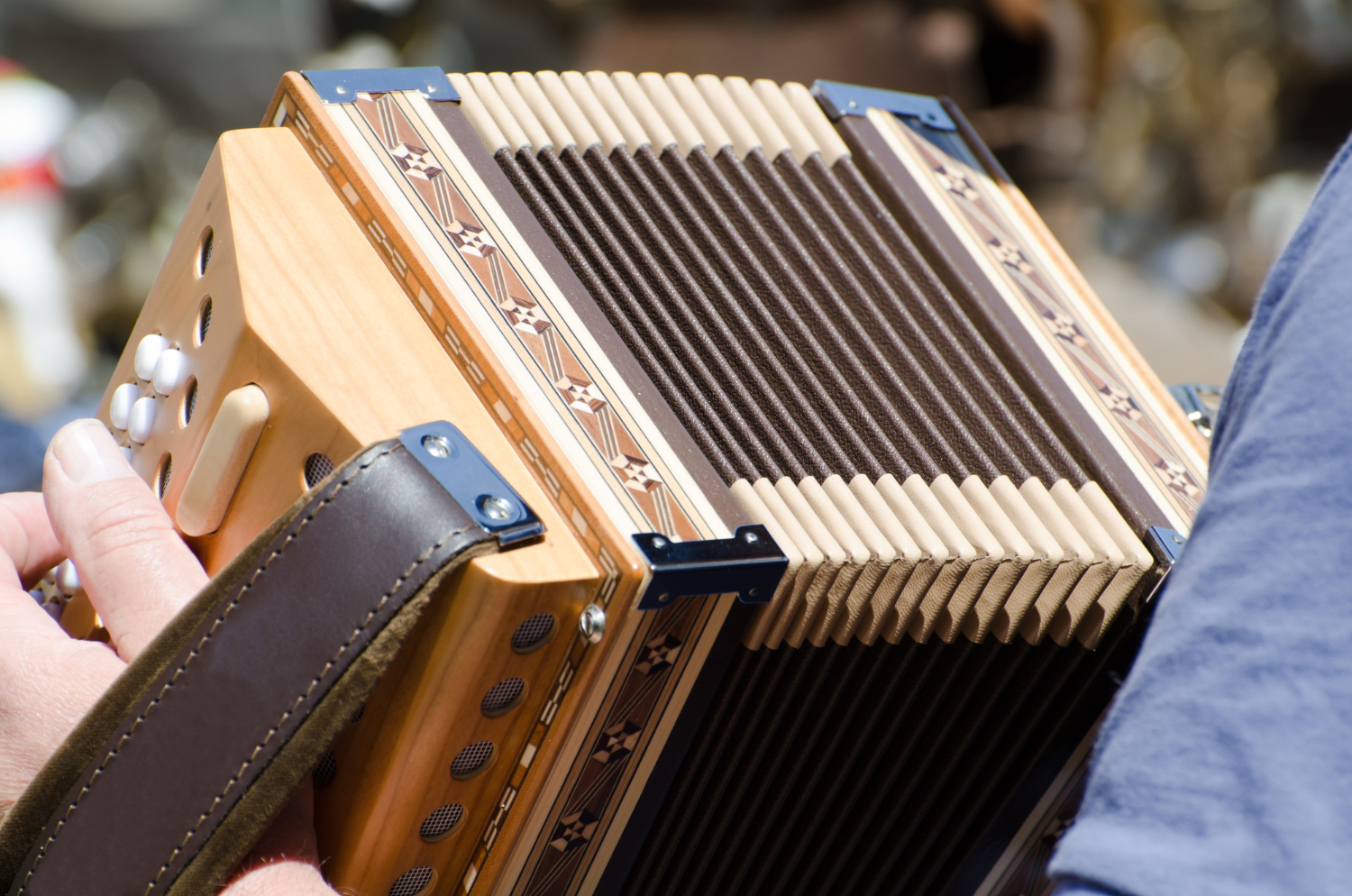
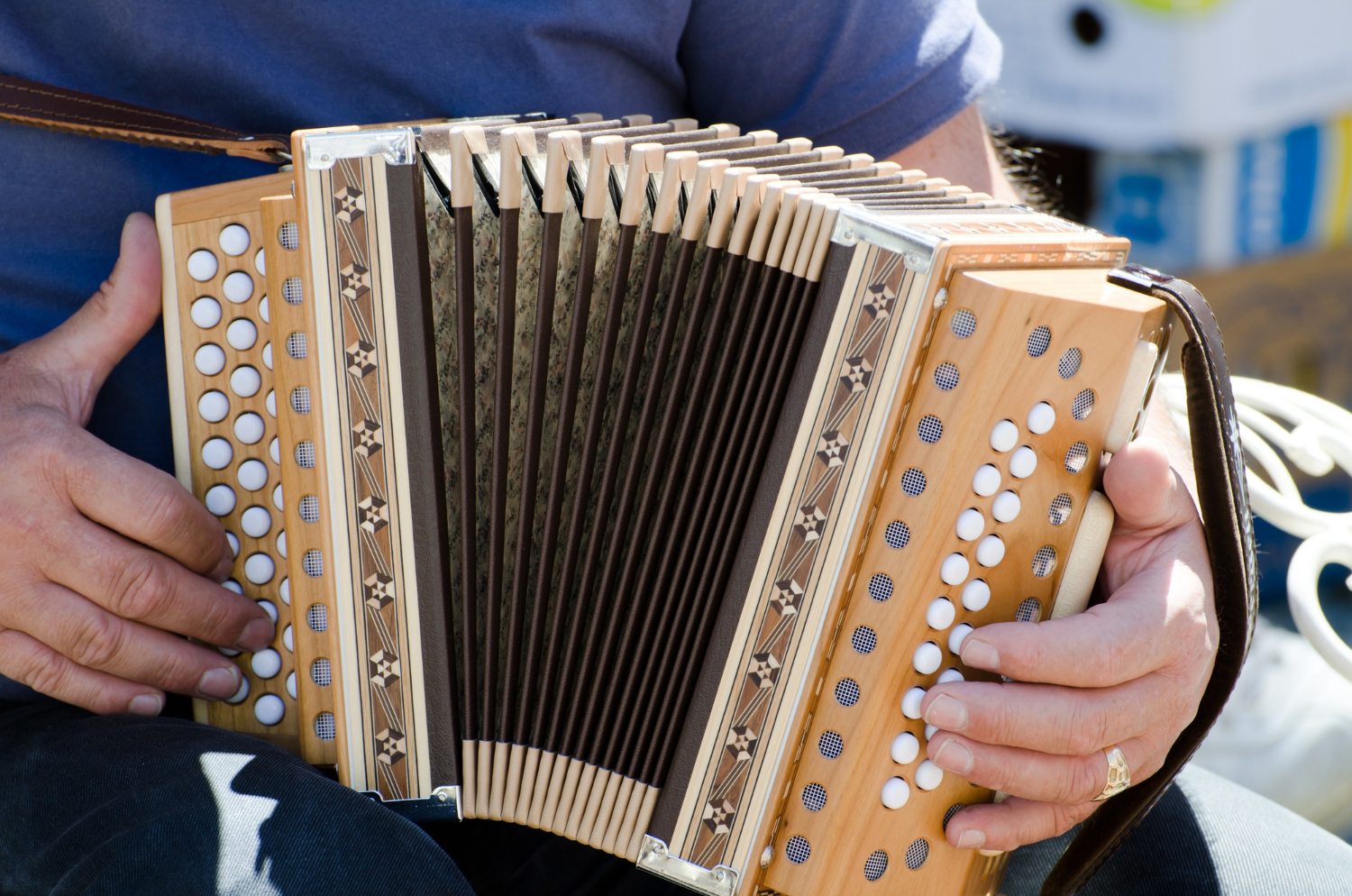
Also called a melodeon in Britain and Australia. In Ireland melodeon means a one-row instrument specifically, while two and three row ones are called button accordions. This is the bisonoric family.
Each row plays the notes of a single diatonic scale, so the instrument is built for particular keys rather than for all of them. The bass side is arranged in pairs, one button sounding the root of a chord and its partner sounding the triad. One-row instruments traditionally carry two or four bass buttons, two-row instruments eight, three-row instruments twelve.
This is the accordion of Cajun and zydeco music, of Irish and Scottish traditional playing, of norteño and vallenato, of English and French folk. It is not a compromised version of a chromatic instrument. It is a different instrument that happens to share a name.
Why the diatonic question is really a genre question
If you are drawn to a diatonic instrument, the choice of tuning is effectively a choice of repertoire, because traditions have standardised on particular ones.
- B/C is the main system for Irish and Scottish music
- C♯/D is less common and used mainly in Irish music. Irish-American players in the mid twentieth century used it with the rows reversed
- D/G became the standard in England in the later twentieth century for English traditional music
- G/C and C/F two-row systems, and G/C/F three-row, are common in continental Europe
Three row instruments spaced a fourth apart come in tunings including B♭/E♭/A♭, A/D/G, G/C/F, F/B♭/E♭ and E/A/D. That configuration is known as the international system. By convention the outer row is named first, so on a G/C instrument the outer row is G and the inner row is C.
Extra rows are not only about reaching more keys. Many notes in the additional rows are reversals, meaning the same pitch is available on the opposite bellows direction. That gives the player a choice about whether to change direction at all, and whole styles of playing have grown out of crossing rows to cut down bellows changes and keep the bass side working.
So the honest advice for a would-be diatonic player is to decide what you want to play first, find out what the people who play it use, and buy that. If you are still working out where the instrument sits across different styles, we covered that ground separately in which music genres include the accordion.
The left hand is more similar than you think
Piano accordions and chromatic button accordions usually share the same left hand: the Stradella system, also called standard bass.
Stradella arranges its columns in a circle of fifths, which puts the main chords of a key in three neighbouring columns. That is a genuinely useful piece of design. The chords you need together sit together under your fingers.
A few details worth knowing before you sit down with one:
- Each chord button sounds three pitches. Modern Stradella leaves the fifth out of seventh and diminished chords, which makes them more flexible to build on
- You cannot see the buttons while playing, so a dimple or bump marks the central C in the root row, with further markers four buttons away in each direction on A♭ and E
- The system has no separate octave buttons. Which octave sounds is a matter of the register switches, not of which button you press
The practical point for a beginner: because both unisonoric families share this left hand, time spent learning Stradella is not wasted if you later move from a piano accordion to a chromatic button one. The right hand has to be relearned. The left hand comes with you.
The switches, and why wet and dry matter more than you expect
Every accordion with more than one voice has register switches, and beginners usually treat them as a mystery to be ignored. They are worth ten minutes of your attention, because they decide what the instrument sounds like and that decides whether you enjoy practising on it.
Inside the instrument are reed ranks, each one a complete set of reeds. Most accordions carry between two and four on the treble side and three to five on the bass side. That is what the shorthand means when a seller lists an instrument as 4/5 or 3/4: four treble ranks and five bass ranks, or three and four. The switches select them singly or in combination.
The ranks are named the way organ stops are, by pipe length. The 8 foot rank sounds at unison pitch and is the reference the others are tuned against. A 4 foot rank sounds an octave above it and adds brightness on top of the heavier reeds. A 16 foot rank sounds an octave below.
Here is the part that changes how an instrument feels to play. Where an accordion has two 8 foot ranks, one of them is tuned slightly sharp of the other, usually by no more than about 25 cents. Sounded together they beat against each other, and that beating is the tremolo you recognise as the accordion sound. A small difference gives few audible beats and is called dry tuning. A larger one is called wet. Instruments with three 8 foot ranks put the third the same distance below the centre rank, which doubles the effect.
Dry suits jazz, classical and anything where the accordion has to sit inside an ensemble. Wet is the French musette and much folk playing. Neither is better, but an instrument tuned the opposite way to the music you want to play will quietly put you off it, and retuning is a job for a technician rather than something you adjust at home. Ask about the tuning before you buy, and listen to the instrument with a single 8 foot rank selected and then with both.
So which one should you buy?
Work through these in order.
Do you already play piano or read music? Start with a piano accordion. You will be playing tunes in weeks rather than months, and the early weeks are where most people quit.
Is there one tradition you want to play, and nothing else? Find out what that tradition uses. If the answer is a diatonic instrument in a particular tuning, buy that and ignore everything above about range and chromaticism. You are not giving anything up, because the music was written for the instrument.
Do you want the widest range and the most transferable technique, and are you willing to be slower at the start? Chromatic button. Five octaves plus a minor third is a lot of instrument, and patterns that move between keys pay off for years.
Do you not know yet? Piano accordion, small. A 48 or 72 bass instrument is easier to hold, easier to resell and teaches you the Stradella left hand that carries over if you switch. Nothing about starting there closes a door.
Things beginners get caught by
Buying too big. A 120 bass instrument is the full size standard, and it is a lot to hold up while your technique is still forming. More bass buttons than you can reach is weight you are carrying for nothing.
Assuming button means diatonic. It does not. Chromatic and diatonic button accordions look similar from across a room and work on completely different principles. Check whether the instrument is unisonoric or bisonoric before anything else.
Buying a vintage instrument first. Old accordions turn up cheaply because they often need work, and reeds, valves and bellows all age. If you do go that route, know what you are taking on. We wrote up what restoring a vintage accordion involves separately.
Confusing an accordion with a concertina. They are related free reed instruments with different keyboards, different sizes and different repertoires, and some concertinas are bisonoric as well. We set out the differences between concertinas and accordions in an earlier piece.
What to check when you have one in your hands
Whether you buy new or second hand, the same few minutes of checking tells you most of what you need to know.
- Work the bellows slowly with no buttons pressed. A healthy instrument resists. If air escapes freely, it is leaking, and bellows work is specialist
- Play every note on both push and pull. You are listening for anything slow to speak, silent, or wavering in pitch. On a bisonoric instrument this takes twice as long and is twice as necessary
- Press every bass button. Same test, and also check you can find the marked C by feel, since you will never see these buttons while playing
- Run through the register switches. Each one should change the sound and none should stick
- Put the straps on and stand up. Sitting down flatters every accordion. The weight question only answers itself standing, and it is the main reason a bigger instrument gets practised less
One note on the chromatic family if you are shopping internationally. The Russian bayan is a chromatic button accordion, and across the former Yugoslavia a six row layout based on the B system is used, called the dugmetara, often paired with a 140 bass Stradella side. These are not beginner instruments, but you will see them listed alongside ordinary ones and it helps to know what you are looking at.
The one line version
Pick unisonoric or bisonoric first. If you want to play one folk tradition, buy the diatonic instrument that tradition uses, in its tuning. If you want to play broadly, go unisonoric, and start on a piano accordion unless you are sure you want chromatic buttons. Buy smaller than you think you need, because the instrument you actually pick up is the one you learn.
Common questions
A piano accordion is easier to start on if you already play keyboard or read music, because the right hand layout is one you know. If you have no keyboard background, neither type is clearly easier, and the bigger question is whether you want a unisonoric instrument that gives the same note on push and pull, or a bisonoric one that does not.
A chromatic accordion is unisonoric and has every note available, so it plays in any key. A diatonic button accordion is bisonoric, meaning each button gives a different note on push and pull, and each row plays a single diatonic scale, so the instrument is built around particular keys.
Mainly the diatonic button accordion in B/C tuning, which is also used in Scottish music. The C sharp and D system is less common and used mainly in Irish music. In Ireland the word melodeon is reserved for one row instruments, with two and three row ones called button accordions.
It is the number of buttons on the left hand side. A 120 bass instrument with 41 keys is the full size standard for a piano accordion. Smaller instruments come in 96, 72, 48 and 12 bass, and for a beginner a smaller one is usually easier to hold and learn on.
It describes how far apart the two middle reed ranks are tuned. Where an accordion has two 8 foot ranks, one is tuned slightly sharp of the other, usually by no more than about 25 cents, and the beating between them is the tremolo you hear. A small difference is dry, a larger one is wet. Dry suits jazz and classical playing, wet suits musette and much folk music.
Yes, and the left hand transfers. Piano accordions and chromatic button accordions usually share the Stradella bass system, so your left hand knowledge carries over. Only the right hand has to be relearned. Moving to a bisonoric diatonic instrument is a bigger change, because the bellows become part of choosing the note.