





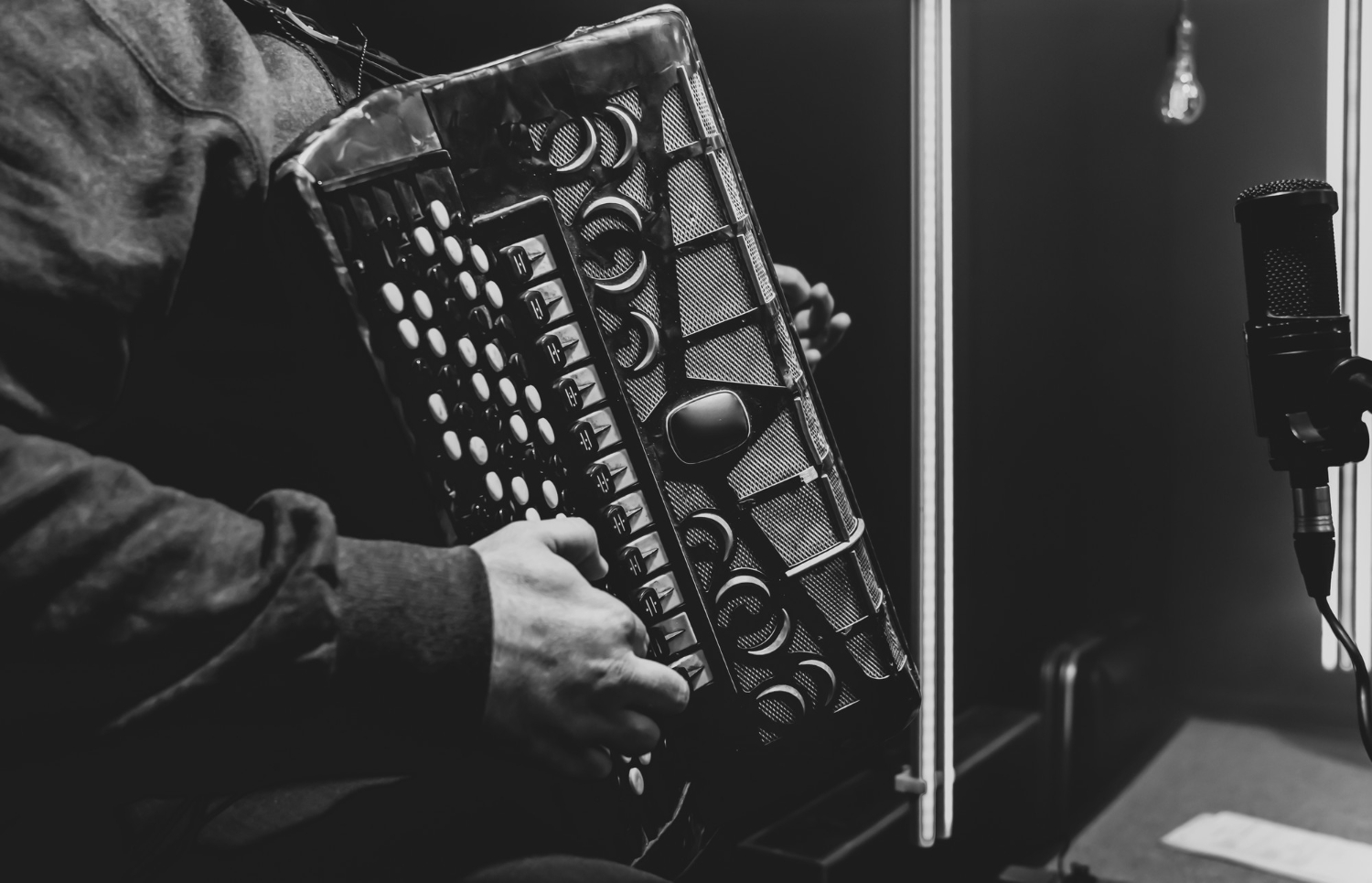
The accordion belongs to folk and dance music, and it has for nearly two centuries. What has changed is that you no longer need an accordion to use one. Sampled libraries and modelled instruments put the sound inside a laptop, which has quietly pulled it into genres that never touched it before.
This piece covers both halves: the traditions the instrument actually comes from, and where producers are putting it now.
The Traditional Homes
- Cajun and zydeco in south Louisiana, the first built around a diatonic box and a fiddle, the second around blues and a rubboard.
- Conjunto and norteno on the Texas and Mexico border, accordion paired with the bajo sexto.
- Vallenato on the Colombian Caribbean coast, accordion with caja and guacharaca.
- Forro in northeast Brazil, accordion with zabumba and triangle.
- Tango in Argentina, played on the bandoneon rather than the accordion proper.
- Musette in the Paris dance halls, and liscio in Italian ballrooms.
- Irish and Scottish traditional music, button accordion and melodeon.
- Klezmer and Balkan music, ornamented and modal.
Every one of those is dance music, and every one adopted the instrument for the same practical reason. It was loud, self contained and affordable at a time when none of those things could be taken for granted.
Where It Turns Up Now
Film and Game Scores
Composers reach for an accordion or a bandoneon when a scene needs to feel located somewhere specific, usually European or Latin American. It has become shorthand for place, and a sampled library delivers that in an afternoon.
Folk Influenced Indie and Alternative
Bands wanting an acoustic texture that is not another guitar have used accordion steadily since the 1990s. It sits in a frequency range guitars leave open and it sustains, which gives an arrangement a bed to rest on.
Electronic Music
Sampled accordion riffs show up in house and EDM, usually chopped from polka or musette phrases, and bandoneon loops appear in downtempo and electronic tango. The instrument becomes a texture rather than a lead.
Pop
Mostly as a single hook or a verse texture. A short accordion line reads instantly as nostalgic or European, which is useful to a producer and the whole reason it gets booked.
What Gets Lost in Translation
A sampled accordion plays notes. A real one is played with the bellows, where volume and attack are shaped continuously by the player. Libraries address this with a controller mapped to expression, and it helps, but the phrasing that makes a vallenato or a tango line sound alive is bellows work. That is a performance, not a patch.
Which is the honest summary of the digital era for this instrument. The sound is now available to everyone, and the playing still is not.
One thought on “What Music Genre Often Includes an Accordion? A Digital-Era Exploration”