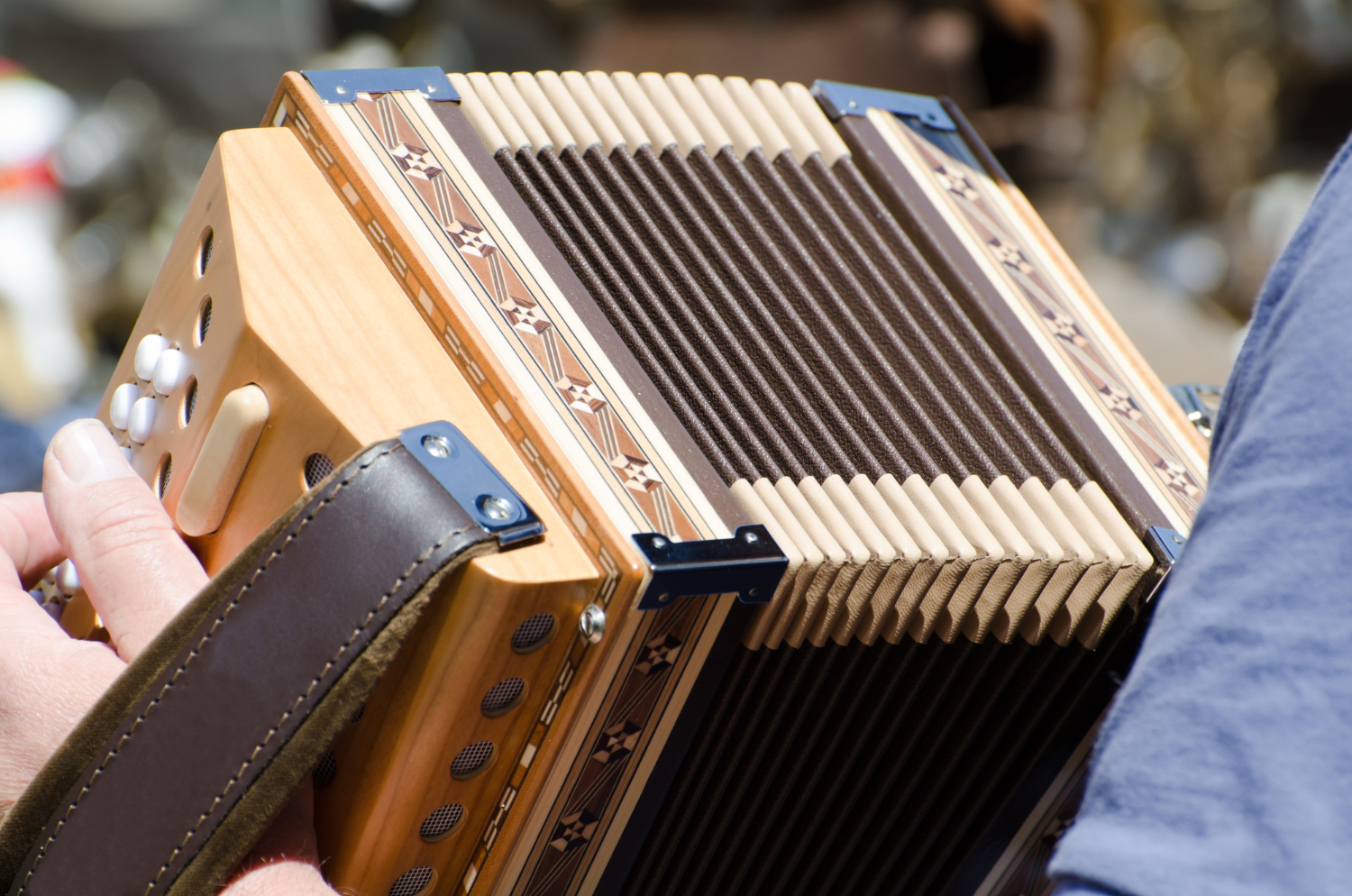




Accordion reeds are where the sound starts. Steel tongues riveted to metal plates sit inside the instrument, and the air the bellows drive past them is what you hear. The keyboard, the grille, the reed blocks and the case decide how much of that sound reaches you and what it turns into on the way.
Joe Petosa, writing for petosa accordions, makes that second half of the point against his own trade, under a heading saying reeds are not everything. It is not the strings of a Stradivarius that make it a Stradivarius, and accordion reeds alone do not make a fine accordion. No tonal characteristics are present until the reeds are mounted on a reed block and the block is secured to the shell, and a handmade reed fitted inside a lower quality instrument keeps the attributes of a handmade reed while lacking beauty of sound and tone. The reed maker Voci Armoniche reaches the same conclusion in its comparative reed table: quality depends very much and always on how the reeds are assembled and exploited within the instrument.
Both halves matter. Accordion reeds set the ceiling, and the instrument built around them decides how much of that ceiling you ever hear. That is why two accordions with the same reed grade printed on the specification sheet, the same key count and the same number of bass buttons can feel like different instruments to play.
What a reed actually is
The accordion belongs to the free reed family. The Metropolitan Museum of Art describes a free reed instrument as a wind instrument with flexible metal tongues held at one end to a stationary plate, sitting inside the wind chamber, where air passing over the plate sets the loose end vibrating freely. Each reed gives a single pitch, and that pitch is made softer or louder as the player varies the air pressure.
One consequence runs through everything else. Because loudness is a function of air pressure, the bellows carry every dynamic in the music, and pressing a key harder changes nothing at all.
The four parts of one accordion reed
Joe Petosa, writing for petosa accordions, breaks a single accordion reed into four parts: the reed plate, the reed tongue, the rivet fixing the tongue to the plate, and the reed valve.
Technicians use the word differently from players. The reed maker Voci Armoniche sets it out in its published answers on reeds: a reed is two high carbon steel tongues, an aluminum alloy frame called a plate, and two rivets holding the tongues to it. Petosa explains the arrangement, with one tongue mounted on each side of the plate to give a voice for each direction of the bellows, push and pull, so a single plate serves both. An accordion reed, to the person who repairs it, is that whole assembly rather than one sounding tongue.
What accordion reeds are made of
The tongues are spring steel. Petosa names Swedish blue steel. The Czech maker Harmonikas publishes figures for the accordion reeds it supplies: tongues of Swedish steel at 2,000 newtons per square millimeter, tolerance class T3, ground to twenty cents below the base tone, with a head width of seven to nine millimeters at the rivet and a corrosion protection treatment applied. That last item is worth reading twice: steel that thin, in a chamber full of warm damp air, is treated against rust at the factory for a reason.
The plates are aluminum. Harmonikas gives dural aluminum sheet at 160 HB hardness, with the channels cut by electro erosion and the sides of each reed plate grooved so wax grips better. Petosa adds that hand made accordion reeds use Avional, a copper and magnesium and silicon alloy also sold as duraluminum, while machine made sets use a softer aluminum alloy with iron rivets.
The gap you cannot see
The clearance between the tongue and the wall of the opening it swings through is measured in ten thousandths of an inch, and it decides whether the reed speaks cleanly at all.
Petosa puts that side gap as small as five ten thousandths of an inch. Too wide and the reed wastes air. Too tight and the tongue touches the plate and buzzes. Harmonikas publishes its own figures in metric, which describe the gap on the accordion reeds it produces rather than restating the Petosa number, so the two do not convert into each other: 0.03 millimeters each side at the rivet and 0.04 millimeters at the tip, with the lower side of the channel widened relative to the upper layer. A production account written by Voci Armoniche and published by Accordions Worldwide in 2003 puts the hand filing tolerance at a hundredth of a millimeter across more than four hundred distinct note profiles, and says the tongue is still centered in its opening by hand, with a hammer and anvil.
This changes how you listen to a sick instrument. A note that buzzes, speaks late or needs a shove of air to start is usually not out of tune but out of position, and no amount of tuning fixes a geometry fault.
The grades accordion reeds are sold in
Accordion reeds come in three broad grades, and the names are Italian because the trade is. Machine reeds, voce a mechanica. Hand finished reeds, tipo a mano. Hand made reeds, a mano.
What physically differs is narrower than the names suggest. Petosa sets it out. In a hand made set the tongues are cut from a strip of steel and paired back to back, sanded on a slow speed wet sander, filed by hand, then separated and riveted to the reed plate one at a time, with the plate openings filed and polished to clear the burrs. In a hand finished set the tongues are stamped out of sheet, which weakens the tempered steel and leaves the tongue more vulnerable to breaking, and the faster run gives less consistency. In a machine set the tongues are stamped, sanded at higher speed and riveted by machine. The finest hand finished accordion reeds, prima tipo a mano, match hand made reeds except that the tongue base is slightly narrower, stamped rather than cut, and the tongues are not paired. Voci Armoniche dates the tipo a mano reed to a design by Luigi Antonelli in 1952.
Here is the part that usually gets left out. The people who make the reeds say the grades are a rough guide. Voci Armoniche’s own comparative reed table calls the three way split indicative only, warns that it risks being simplistic and inaccurate if taken literally, describes it as an outdated classification, and says that above all it ignores the differences between accordion reeds of the same category made by different manufacturers. Its own range is the evidence for that. Since 2021 the BlueStar reed has replaced the handmade reed at the top of it, and the range now runs to four types, BlueStar, handmade, hand finished and commercial, rather than the familiar three. Petosa says the same from the other end of the bench: some machine reeds are better than some hand finished reeds, and some hand finished reeds are better than some hand made ones.
The vocabulary is not standardized even inside one company’s catalog. Hohner prints a reed plate quality line on its own specification sheets, and the entries are not interchangeable words on a single scale. The Hohner Gola is listed as A Mano. The Hohner Mattia IV 120 is listed as H2. The Hohner Bravo I 49F is listed as standard. Three models, three vocabularies, one manufacturer.
Treat the grade as a filter rather than a verdict. It narrows the field without telling you which of two instruments in front of you is the better one.
What better accordion reeds actually buy you
Air efficiency, mostly, and the musical consequences that follow. Petosa’s account is that hand made accordion reeds use less air, which gives the player more expression and a wider dynamic range, and that they hold pitch longer. The test he offers is worth carrying into a shop, and it works on any grade of accordion reeds: a reed’s pitch should change as little as possible between the quietest playing and the loudest, and the less it moves, the better the reed.
Players feel this long before they can name it. With a thirsty set you run out of bellows before you run out of phrase and the long notes sag.
Reed valves, which fail before anything else
A reed valve is a flap glued over the opening beside the sounding tongue. Its job, as that 2003 Accordions Worldwide account puts it, is to stop air escaping through the hole of the tongue that is not working.
Both sources agree that plastic has largely taken over. Petosa writes that the valve is leather or, more commonly used today, synthetic leather or mylar. What they do not agree on is whether that is a loss. Petosa calls the reed valve the single biggest influence on response, tuning and tone after the reed itself, says genuine leather seals the aperture best and gives a subtle warm tone, and judges synthetic leather, mylar and felt to give less than optimal tone, response and longevity. The Voci Armoniche account says the plastic valves, called ventilli, had improved enough to compare positively with leather. That second verdict was written in 2003, so read it as the moment plastic became respectable rather than as a reading of today’s bench.
They agree on what matters for diagnosis. The valve has to lie flat against the reed plate, and Petosa is explicit that one which is not flush changes the airflow and the pitch. A curled valve is a fault whatever it is cut from.
Nothing in there is screwed down
Most reed plates are bedded into the reed blocks with a compound of beeswax and resin. Petosa says so, and adds that some accordions use nails or screws alone, which changes the timbre. Harmonikas grooves the sides of its plates specifically so the wax holds better to both the reed plate and the block.
Put those together and the instrument is more delicate than the casework suggests. The reed plate is held by wax, the tongue is held in the plate by a rivet set by hand, and neither is a fastener anyone can tighten. Petosa names the consequence outright: the main factor deciding how long an accordion lasts is the point at which the reed wax dries hard and brittle, so the plates are no longer secured and the reed valves have lost their elasticity. Putting that right means stripping every plate and valve, cleaning, rewaxing and retuning the whole instrument. That is the real argument behind the storage habits in our guide to cleaning and restoring a vintage accordion. Petosa adds a second route to the same place. When the bellows open, air and particles are drawn inside, a share of them settle on internal parts including the reed tongues, and those particles change an accordion reed’s pitch, so keeping the inside of the instrument clean is tuning work rather than housekeeping.
Reed ranks, footage and what a switch does
Reed ranks are labeled by organ footage. Petosa gives three marks: L for the sixteen foot low set, M for the eight foot middle set, and H for the four foot high set, with LM, LMH and LMMH as the common combinations.
A register switch adds nothing to an accordion. It opens and closes reed ranks already sitting in the instrument, and Hohner’s sheets make the point without meaning to. The Hohner Gola basic model is 41 piano keys, four voices and 120 basses, and its sheet lists eleven registers and eleven tone colors. The Hohner Mattia IV 120 sheet lists thirteen registers and eleven tone colors. On one model the two counts match and on the other they do not, which is the tell: a register count counts switches, not distinct sounds, and the voice count sets the ceiling. Both sheets also list two voices in cassotto at sixteen foot and eight foot, so the chamber the reed blocks sit in is part of the specification.
How accordion reeds are tuned
Tuning a reed means removing metal, and the direction of the change decides where it comes off. The 2003 Accordions Worldwide account describes the sequence: material comes off the tip of the tongue to raise the pitch and off the body to lower it, the first tuning is done by hand with a tool called a stecca or with a grinder that must not overheat the tongue, a second tuning brings a set to A equals 440 hertz, and the final tuning happens at the accordion factory after the reed valves are fitted and the reeds are mounted in the reed blocks. Harmonikas hand tunes with emery cloth and holds the base profile to within five cents.
Two things follow. A reed can only be tuned so many times, because every pass takes steel away and nothing puts it back. And the pitch on a second hand instrument may never have been 440: Petosa notes that accordions are commonly tuned somewhere between A442 and A444, before any deliberate detuning. Concert tuning sets the eight foot reed ranks in unison for a dry sound, while musette tuning offsets one or two of the middle reed ranks so they beat against the other, and Petosa notes that the size of that beat is counted in cents.
What goes wrong with accordion reeds
- A note that speaks late or not at all at low pressure. Usually clearance or a reed valve rather than tuning. Test it by playing the note as quietly as you can hold it.
- A buzz on one note in one bellows direction only. The tongue is contacting the reed plate, or something is sitting in the channel.
- Pitch that sags when you lean on the bellows. Petosa’s measure of reed quality, read in reverse.
- A note wrong on one register and right on another. That isolates the fault to a single rank, which is useful information to hand a technician.
- Several notes flat together across one of the reed ranks. Age and playing hours rather than an accident.
- A note that has gone dead after years in a case. Often a reed valve that has curled away from the plate rather than anything structural.
What you can check and what you should not touch
Checking by ear costs nothing and risks nothing. Play every note on the push and on the pull, with each register in turn, listening at the quietest pressure you can sustain rather than at full volume, because quiet playing exposes clearance faults that loud playing hides. Petosa also sets the bar for what good looks like, which is that a high quality instrument should stay in relative tune even after decades of use.
Two visual checks are worth having done, and the words to stress are having done. Petosa says to inspect the reed tongues and the reed valves: reeds should show few file marks, and reed valves should sit overall flat to the reed plate. Reaching them is not an owner’s job. A treble grille is screwed or clipped on and cracks or bends when it is levered off, the register linkage runs through the grille on chin register models, and the reed valves behind it curl or tear if they are touched or wiped, which is the same reed valve fault that kills a note after years in a case. Ask the technician who already has the instrument open, or a seller willing to open it, and look without touching.
There is also a paper trail. Voci Armoniche states in its published answers on reeds that a complete treble and bass set ships with an adhesive certificate of quality and origin applied to one of the reed blocks inside the instrument, plus an exterior certificate tied to new accordions, and that one reed in the center of the treble section carries the company mark engraved on the plate. If the certificate carries only the neutral wording, it refers to the commercial grade. A buyer who can see the reed blocks is not relying on a seller’s word about which accordion reeds are inside.
What should not be opened by the owner is everything else described here. Retuning removes metal permanently, revalving and rewaxing both involve heat near parts held in place by wax, and reseating a tongue is a hand skill measured in hundredths of a millimeter. The maker’s own advice is blunt: reeds cannot be fitted the way batteries go into an appliance, and the reed blocks have to be optimized to suit the reeds. It adds that obtaining a good diagnosis is often a good part of the solution, because the fault may be the tuning, the valves, the reed blocks or the reeds, and those are four different jobs.
Frequently Asked Questions
Yes. The accordion is a free reed instrument. Inside the wind chamber, flexible steel tongues are riveted at one end to a stationary plate, and air moving past a tongue sets its free end vibrating to produce a single pitch. Harmonicas and concertinas are built the same way. Every accordion reed carries two tongues, one sounding on the push and the other on the pull of the bellows.
It depends on the grade of the reeds, on whether one reed or a complete set is involved, and on how much rewaxing and retuning goes with the job. The labor is the larger part, because the reed blocks have to be matched to the reeds and the instrument retuned afterward. Ask a technician to diagnose the fault first, since the cause is often a curled valve or dried wax rather than the reeds themselves.
Tuning means removing metal from the tongue, and nothing puts it back. Material comes off the tip to raise the pitch and off the body to lower it, with a hand tool or a grinder that must not be allowed to overheat the steel. The final tuning is done with the reed valves fitted and the reeds mounted in the reed blocks, because both change how the tongue behaves. A reed that buzzes or speaks late is out of position rather than out of tune, and filing it makes matters worse.
Yes, although slowly compared with strings. Accordion reeds drift as the steel ages and playing hours build up, and a whole rank often moves together rather than one note at a time. Two common causes sit outside the reed itself. A valve that is no longer flush with the reed plate changes the airflow and the pitch, and wax that has dried hard lets a plate shift in its block.
There is no fixed interval, because it follows playing hours, reed quality and storage rather than the calendar. Petosa offers a useful benchmark from the manufacturing side, which is that a high quality instrument should stay in relative tune even after decades of use. In practice the trigger is what you hear: tune when one rank has drifted against the others, or when a tremolo has lost its evenness across the keyboard.
It is possible and it is rarely advisable. Every pass takes steel off the tongue permanently, so a mistake cannot be corrected. The guidance from the reed maker is blunt: reeds cannot be fitted the way batteries go into an appliance, the reed blocks have to be optimized to suit the reeds, and the work ends in a final tuning. Start with a diagnosis, because the fault is frequently a valve or the wax instead.
It varies with how many reeds are involved and with what has to be put right first. Dirty or lightly corroded reeds and tired valves are normally dealt with before any tuning, because both affect pitch. A full reed overhaul, meaning every plate and valve removed, the reeds cleaned, new valves fitted, a rewax and then a complete tuning, is a far larger job than spot tuning a handful of notes.
Do not leave it anywhere hot or damp. Most reed plates are bedded into the reed blocks with a compound of beeswax and resin rather than screwed down, and Petosa names wax that has dried hard and brittle as the main factor deciding how long an accordion lasts. Voci Armoniche adds that the reeds must never be exposed to humidity or to sudden temperature changes, which put condensation on the steel and start it rusting. Do not put water on the bellows, do not touch the reed tongues with bare hands, and do not go after a single dead note with a screwdriver.
No single name answers that, and the reed grade printed on a specification sheet does not settle it either. Voci Armoniche, which makes reeds, says the familiar three way split into machine, tipo a mano and a mano is indicative only and ignores the differences between accordion reeds of the same category made by different manufacturers. What you can judge for yourself is concrete: how little air the instrument uses, and how well it holds pitch when you play quietly.
What is inside decides it more than the badge on the grille. Wax that has gone hard and brittle no longer secures the reed plates, and valves that have lost their elasticity stop sealing, and correcting both means stripping the instrument, rewaxing and retuning it completely. An old accordion whose reeds still hold pitch and whose valves still sit flat to the reed plate is in a very different position from one that does not.